Posts

Showing posts with the label Cloud

AWS EC2 Instances Per-Second Billing

Image
AWS announced per-second billing for EC2 and EBS Volumes Effective October 2, 2017 Available for On-Demand, Reserved, and Spot Instance Types EBS Storage gains same benefits as well Also applies to Amazon EMR and AWS Batch Amazon Web Services provides flexible, secure and scalable cloud platform for the masses, and according to the Gartner Research, is a leader in this field. Today, they announced another useful feature which will change the level of the playing field again: Effective 10/02/2017, usage of Linux instances that are launched in On-Demand, Reserved, and Spot form will be billed in one-second increments. Similarly, provisioned storage for EBS volumes will be billed in one-second increments. Per-second billing also applies to Amazon EMR and AWS Batch. AWS is used by more than 1 million people from "organizations of every size across nearly every industry," Jeff Bezos wrote in his letter to shareholders. Per-second Billing Advantages With...

Getting Started With AWS Aurora - Part 1

Image
AWS announced Aurora  MySQL compatible database engine last November. Aurora is a fully-managed, MySQL-compatible, relational database engine that combines the speed and availability of high-end commercial databases with the simplicity and cost-effectiveness of open source databases. What is AWS Aurora? Amazon Aurora is a relational database engine that combines the speed and reliability of high-end commercial databases with the simplicity and cost-effectiveness of open source databases. It delivers up to five times the throughput of standard MySQL running on the same hardware. Amazon Aurora increases MySQL performance and availability by tightly integrating the database engine with an SSD-backed virtualized storage layer purpose-built for database workloads. Amazon Aurora's storage is fault-tolerant and self-healing. If the entire instance fails, Amazon Aurora will automatically failover to one of up to 15 read replicas. MySQL 5.6 Compatibility According to the AWS...

How to disable AWS OpsWorks Auto-Update

Image
AWS OpsWorks. Image courtesy of Amazon Web Services Does AWS OpsWorks drive you nuts with its auto-update feature eating up your resources and messing up your deployments? There is now a solution to mitigate that, with manageable agent updates. This recently-added feature allows you to select if you'd like to opt in for agent auto-updates or would you like to stick to a specific (and tested by you) version of AWS OpsWorks. Go to  Add Stack  page, in the  OpsWorks Agent Version  field, choose  Manual update  and pick a version. Try this out today by editing one of your stacks to specify an agent version (be sure to do this in your test environment first). This updates the agents and cookbooks on all online instances in that stack immediately. Click the  Changelog  link to learn about the changes that come with the new agent. You can also update the agent on a single instance instead of the entire stack by selecting a version on the...

You can get Shopify POS (point of sale) for free!

Image
If you are an avid Shopify user, and have been undecided whether to get yourself a Shopify POS app, now its the perfect time to make up your mind, because today Shopify announces that selling in person just got a whole lot easier - their point of sale (POS) app, Shopify POS , is now available on the iPhone, and it's free for all Shopify merchants. With the new Shopify POS, you can now accept cash, credit, debit, and gift cards on your iPhone and iPad . Brick and mortar businesses can use our new Retail Package for more advanced features. Shopify POS seamlessly integrates with your online store so your products, orders and customers are always in sync. Bridging this gap between online and offline selling is an important step forward in our mission to make commerce better. Shopify POS is perfect for merchants that sell at farmers markets, pop-up stores, or even coffee shops on the weekend. Get your free Shopify POS (Point of Sale) app here . You will need Mobile Cred...

AWS Announced Simplified Reserved Instances (no-upfront)

Image
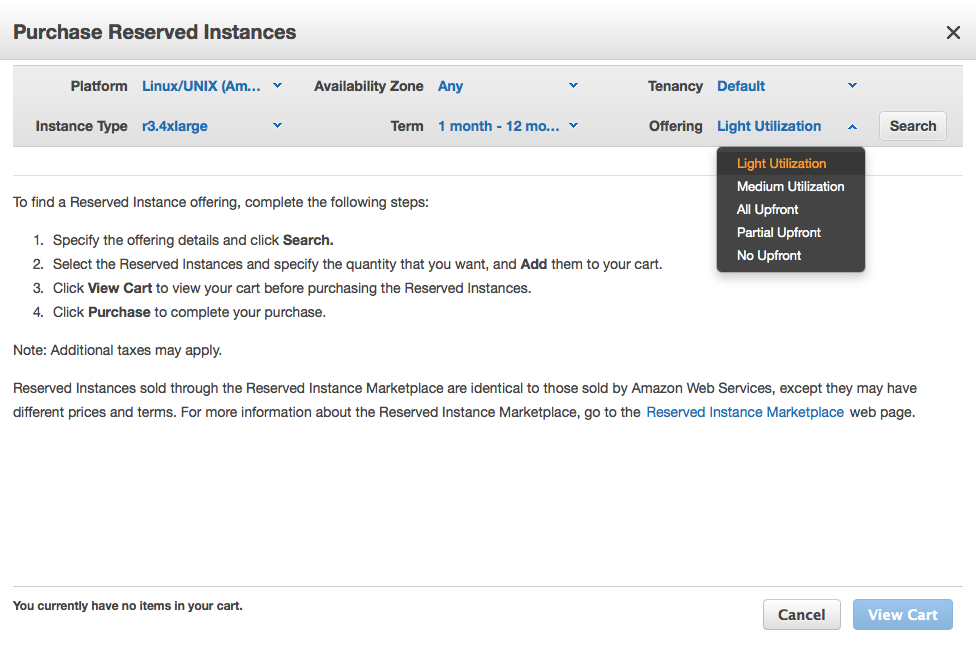
Simplifying the EC2 Reserved Instance Model There is now a single type of Reserved Instance and it has three payment options. All of the options continue to provide capacity assurance and discounts that are typically around 63% for a three year term when compared to On-Demand prices. There are three payment options that so that you can decide how you would like to pay for your Reserved Instance throughout the term (in descending order of effective discount), and you can find these new options under the Offering  settings when purchasing Reserved Instances: All Upfront -  You pay for the entire Reserved Instance term (one or three years) with one upfront payment and get the best effective hourly price when compared to On-Demand. Partial Upfront -  You pay for a portion of the Reserved Instance upfront, and then pay for the remainder over the course of the one or three year term. This option balances the RI payments between upfront and hourly No Upfront -...

AWS Announces New Compute-Optimized EC2 Instances

Image
New, "Explosive" C4 instance type from AWS It has been a while since Amazon Web Services (AWS) announced new cloud hardware. For those unfamiliar with the cloud: yes, even cloud computing need actual hardware to run. The update will brings new, explosive c4 compute-optimized instance type on board, and while I still cannot see this type in my AWS console, I'm sure the promised architecture behind it will be good one. Apparently AWS has ordered the specific Haswell CPU from Intel, designed just for EC2: The new C4 instances are based on the Intel Xeon E5-2666 v3 (code name Haswell ) processor. This custom processor, designed specifically for EC2 , runs at a base speed of 2.9 GHz, and can achieve clock speeds as high as 3.5 GHz with Turbo boost. These instances are designed to deliver the highest level of processor performance on EC2.  As said, there are no CPU benchmarks available yet, but I was quite surprised on their c3.large instance type performance and it h...

PHP Developer Cloud to be Closed on September 7, 2014

Image
I received today email notification from Zend Developer Cloud stating that the PHP Developer Cloud (phpcloud.com) will be closed on 09/07/14 for good. Quite surprise (and not so much) from a company as great as Zend. Just FYI - I tried their service only once and after 48 hours of waiting for my virtual instance to become available, I gave up. For your reference, here's the copy of whole email sent today:   Hi Jaan, You are receiving this email because you have created PHP containers on the  phpcloud.com  - Zend Developer Cloud.   When we launched Zend Developer Cloud in 2011, there were few options for PHP developers to experience Cloud development. We set out to deliver a development-only Cloud environment that could provide you a simple and frictionless way to experience development in the Cloud. In parallel, we began working with the leading cloud providers to define Zend Server-based environments that could run your projects at scale once th...